Showing posts with label NOCK. Show all posts

Tuesday, 23 February 2016

No to Rio 2016 ? Zika Virus, Boycotts, Controversies and all that appertains to the Olympic Games

This year is surely not disappointing with its drama-filled headlines and issues around sport. The biggest one at the moment is the Zika Virus which is seen as Brazil's latest hurdle in hosting the largest multi-sports bonanza.
Rio 2016 
While Brazilian authorities have been battling with polluted waters along the Rio shoreline ( as well as diminishing commodity prices, the Zika virus has shaken the very essence of the Games threatening it with boycotts or no-shows by major sporting nations.
Many have even brewed conspiracies such as;
Whatever the case, the impact of the pandemic will surely be felt at the Summer Olympics to be held in Rio in just under 6 months. Even Kenyan sports administrators have mixed feelings of attending the Games with some calling for tighter safeguards or else, while others insist on participating in the spirit of the Games.
Never before have the Olympic Games looked at risk of missing the largest gathering of nations since 1984. Speaking of missing the Games, we shall take a cursory look at some of the Games which either didn't take place or were mired in controversy, leading to boycotts or low attendance.

1916 Berlin Games logo - courtesy
1916: The VI Olympiad at the Berlin Games in Germany - with the world tottering towards an arms race thanks in part to the German empire and emerging disquiet in parts of Europe, the Games were not held. This is to avoid endorsement of the German Reich as the Games had suddenly become important social and political platforms. 


1940 and 1944 XII and XIII Olympiad in Tokyo-Japan (then Helsinki-Finland) - by now the dalliance of the Games with political and warring regimes seemed to be buttressed. While Japan had won the rights to host the Games, it got into war with its larger (and by then less developed neighbour) China in the 2nd Sino-Japanese War. The IOC hastily awarded the Games to Helsinki, Finland only for the cold weather to rule the Games completely off. Given the 1940 Games debacle, the World War II meant that no Games were held in 1944, though the Summer Games had been awarded to the Britain's London. 

Kenyan Olympic team 1956 - image courtesy of Kenya Archives
1956 XVI Olympiad in Melbourne, Australia ( and Stockholm, Sweden) - these Games had two hosts thanks to the quarantine of livestock and animals meaning the equestrian events - horse jumping were held in Stockholm. The rest of the world or what remained after the boycott of the Chinese Republic, England, Iraq, Lebanon, Netherlands, Spain and Switzerland to make a statement of their political positions. See it's a joke when the virus is on the loose.... 
Kenya participated in its first Olympic Games though still as a British colony. This was one year after the establishment of the National Olympic Committee Kenya (NOCK). This would be the only Games that Kenya never won a single medal too (thus far, yaiks...)

1976 XXI Olympiad in Montreal, Canada - Tanzania managed to rally 22 other African states to boycott the Games ( including our very own Kenyan state). This was due to New Zealand's rugby team the All Blacks tour of South Africa , which was still suspended from the Games due to its apartheid system of governance. This meant the world was denied the exploits of one Henry Rono among other top athletes and sports personalities of that time. 
1976 Montreal memento - courtesy of www.olympics.com

The Games also were occasioned by one of the largest debts ever to hit  host city which was finally repaid 30 years later in 2006. They also had one weird mascot - don't know whether it was a beaver but it surely doesn't inspire much confidence.

1980 XXII Olympiad in Moscow, (then USSR) - The height of boycotts had reached its zenith and the US led about 62 nations into boycotting the Games in the Russian city. This was to protest the USSR's invasion of Afghanistan. Although some were in solidarity with the boycott, others were undergoing economic hardships thanks to unstable fuel prices and commodity prices of the late 1970s. The UK was part of the boycott though it sent its athletes under a neutral flag. 
Some of the countries that boycotted the Games ended up participating at the Liberty Bell Classic or Olympic Boycott Games - mainly the athletics disciplines. Kenya participated in these and won two gold medals in the 400m ( Billy Konchellah) and 5000m (Kip Rono) as well as silver in the 4 X 400m Men's Relay.

Julius Korir - courtesy of sporting-page.net
1984 XXIII Olympiad in Los Angeles, USA - To return the favour for the 1980 Games, the USSR and its 14 'satellite states' including Angola, Cuba, East Germany, Ethiopia and Zimbabwe to name but a few decided to boycott. Though the boycott did not achieve much it also led to a similar parallel Games in the form of Friendship Games - sponsored by one exuberant media magnate in the form of Ted Turner. Kenya only participated in the Los Angeles Games after coming off an attempted coup in 1982 and a bruising election in 1983. The team's performance was dismal with only one gold medal in Julius Korir's 3000m steeplechase triumph.

1988 XXXIV Olympiad in Seoul, South Korea - The tumultuous 80s would mark the last of the Games boycotts but surely not without controversies. North Korea boycotted for not being considered as part-host of the Games. Albania, Cuba, Ethiopia. Madagascar, Nicaragua and Seychelles all boycotted for various reasons. The Games would also be the last that East Germany participated as a single state as it would merge with the West Germany to form the Federal Democratic state of Germany. USSR would also participate for the last time as a union of soviet states as it broke in 1989 after the collapse of the union under Pres. Mikhail Gorbachev.
Kenya had one of its best outings winning five gold medals including Africa's first ever gold medal in boxing - with the late Robert Wangila Napunyi winning in the welterweight while Chris Sande won bronze in the middleweight. The athletics field had 4 gold including Paul Ereng (800m), Peter Rono (1500m), Julius Kariuki (3000m steeplechase) and John Ngugi (5000m).
The Games were also marked by the biggest scandal in doping with the positive testing of Ben Johnson who had won the 100m in record time then of 9:79 secs ahead of everyone else. He would be banned for life from the Games. 
The Games also marked the first time an openly gay athlete was forced to disclose his HIV-positive status in rather odd and almost tragic circumstances. Read more on Greg Louganis's diving exploits at the Olympics

These but a few  are some of the many controversies that have dogged the Games. We do hope that this time round there will be no boycotts and the concerns of health and general environmental state of the city of Rio are addressed in time before the Games. Who would want to ruin what would surely be one Samba party to remember? 

For quick Qs and As on the Zika Virus check out this link by WHO.  


Monday, 4 August 2014

Commonwealth Games - Glasgow : Kenya's Gold, Bleed and Ugly

2014 and it is exactly 60 years since a Kenyan sports personality made it to any international sporting event! And this event was the Commonwealth Games in 1954 ( had previously been known as British Empire Games).
Glasgow 2014 - image courtesy of glasgow.com
With such rich heritage and a storied past, the 2014 edition ought to have been a done deal for Kenyan sport but alas! It is another skewed performance from a contingent of 169 athletes and officials. A misnomer of the Commonwealth Games is that fierce competitors, Ethiopia and other North African countries do not participate.
But even without these countries, Glasgow exposed the scope of Kenya's famed athletes. Out of the 13 disciplines, only 3 managed to get to the podium.

Stand-Outs: 
  1. Julius Yego – Javelin Gold standard – first ever field event Gold medal in major c’ships. Even without proper training facilities and technical support he keeps getting better;
Julius Yego - Golden Throw - www.getty.com
2. Eunice Sum – 800m – she's the reigning world champ and she turned up for the another sterling performance;3. Caleb Ndiku – 5000m – coming of age, he was named 2010 SOYA most promising athlete and showed why. Exit Ezekiel Kemboi too we have another performer...
Disappointments:
David Rudisha – 800m Silver - World/Olympic champ & WR holder, we expected nothing short of Gold, even with a poor season so far;
Jason Dunford – Swimming - he finally admitted frustrations/lack of Kenya's Swimming Federation support ( and no officials are sacked..???);
Kenya 7s team – after finishing 2nd in the table standings in the preliminaries, they met their match in New Zealand who ended our first rugby Commonwealth medal chances
Special Mentions:
  1. Conrad Nkanata – US-based sprinter – finished 3rd in his 200m heat, with proper training he can be a future sprinter;
  2. Benson Gicharu – Boxer – even with time running out for his amateur boxing career, he is still punching it out at major sports events

Kenya Sports (Mis)management:
The charade of Kenyan officials in managing the team continued. First it was delayed allowances due to athletes. Second was the kit issue with missing or delayed kit to Team Kenya.  Third was late accreditation which meant missed attendance by cyclist, David Kinjah among others. Fourth and it’s truly out of personal frustration was lack of technical/financial support as well as favouritism in team selection. These last were raised not just by non-traditional disciplines but also swimmers such as Jason Dunford who may have had his swansong representing the country in any sport.

Golden Girls - 3000m s'chase Kenyan trio
We have said this before and shall repeat it for the umpteenth time. Kenya’s sport management needs to change RADICALLY! Why have more than 10 disciplines and only 2-3 have any chance of winning medals? Can more investment be made on a few of these or if all disciplines are represented, get proper exposure to have winning chance(s).
  •    Kitting – what business goes on with kit which has been acquired for national duty? Why should some official conveniently forget to order this in time? Other times they issue it to non-participants or stock it in local shops. Sponsors should also review such misdemeanor and cancel contracts for misallocated kits.
  •    Allowances – we saw the embarrassment of African teams in World Cup. It did not even take a month before our own officials replicated that same template. Why should individual be charged with responsibility of managing team finances? In future all participants should supply account details and monies sent direct to them like regular pay.
  •    Size of squad – how many officials are really needed to attend international events even when their disciplines have no chance of winning a bronze medal? Participation should be on how successful a sport is at regional, continental or international duty.
  •    Technical/Financial details – for most disciplines Kenya has lost a semblance of international standards. From boxing, swimming to even some athletics events, the edge of advances in technical knowledge is lacking. Spotlight is on sports federations’ internal wrangles and lack of international best practice to compete at such levels.
As usual we shall be treated to excuses and made to forget what has become perennial under-achieving by our national team(s). As a nation,we need to demand accountability from those in charge of our sports bodies. The Government must also stop playing deaf and be more forceful in getting officials to straighten their act. 
It is no wonder that most athletes prefer running in Grand Prix events, others opting to quit even before their prime as a frustrated lot. See what is happening to the football fraternity? 

Thursday, 15 November 2012

Paul Tergat nominated to head National Olympic Committee-Kenya...Good Choice

Having served to the mandatory age of 70 years, Kipchoge Keino is calling it a day at the helm of the  National Olympic Committee of Kenya. He held office since 2000 after taking over from then beleaugered Charles Mukora who had resigned after the Salt Lake City games debacle that rocked the IOC. In the 12 years at helm, Mr. Kip Keino has managed the best and one of the worst of performances by a Kenyan team in country's Olympic history. The most recent bad performance in London is one sticking point.
The speed-cop has also managed to keep steady the NOC-K but being a semi-independent sports body from the local national sports federations and associations, it has not been an easy task. His regular spats with the one of the most powerful sports association Athletics Kenya for example is another of the unforgiving jobs he had to do while as NOC-K Chair.
We shall not enumerate his major undertakings as Chair or shortcomings for now. That's for another day/post. We wish him well as he takes up his position as honorary member of the IOC.
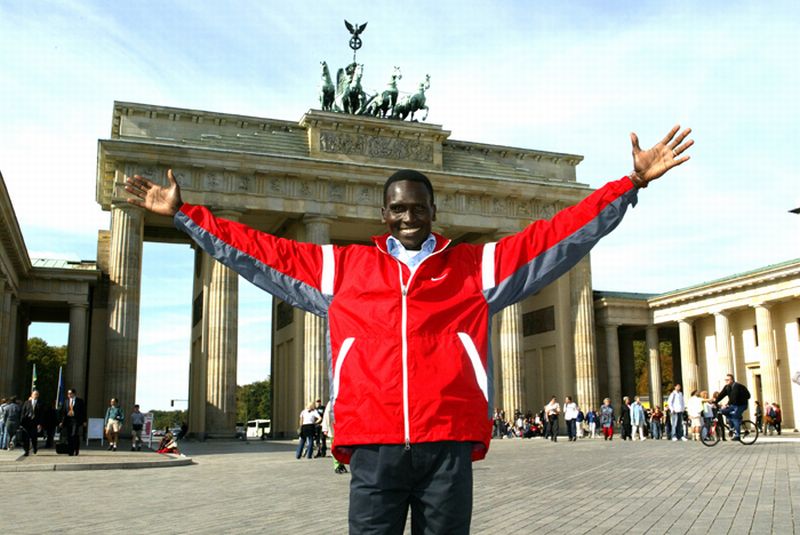
Paul Tergat  - image courtesy of www.runblogrun.com

In comes Paul Tergat. Now if ever there was an athlete who would rival Kipchoge Keino in terms of both national and international appeal, it is Paul Kibii Tergat. He has been on the running circuit until injury and loss of form made him leave the tracks and roads last year. His 5 consecutive titles on the world cross-country circuits, half-marathon and marathon races as well as his memorable but disappointing 2nd place finishes at the Atlanta and Sydney Olympics to another athletics legend Haile Gebreselassie.
Beyond his running exploits he has set up the Paul Tergat Foundation and also set up a private sports marketing firm, FineTouch Communications which handles the SOYA (Sports Personality Of the Year Awards) - an event used to honour Kenyan sports men and women who have excelled within a certain calendar year as well as honour those teams and past heroes too. He has also been serving as a Goodwill Ambassador for WFP- World Food Programme.
And though his sports organisations management may be in doubt, he has cultivated a relationship of mutual respect and honesty with Kenyan corporate firms and sports bodies - a rare feat for many sports people both active and retired. He has also been known to be a consensus builder and has business acumen which he will need to muster to run the NOC-K which still needs regular funding to meet its obligations.
As a former Olympian he did manage to embody the spirit of sportsmanship by not only losing gracefully two times to the same athlete but also cultivating a healthy relationship with his nemesis Gebreselassie. The two took battle from the cross-country tracks to the race tracks in the 10,000m to half-marathons and full marathons. They even broke world records in the marathon between themselves before Kenya's Patrick Makau took the course record in Berlin last year.
We do applaud him on his nomination and do hope the IOC picks him to represent Kenya in the greater Olympics body. It should also be noted that other Kenyan sporting bodies should take the lead of the NOC-K to nominate, vet and elect officials who's track record speaks for itself. Too many charlatans in town are costing Kenyan sport as great fortune and goodwill from their international peers.
Godspeed though to the "Gentleman''  !
  

Monday, 6 August 2012

Olympics 2012 - Kenya busy missing Gold, what gives?

This weekend marked the start of the athletics programme in the ongoing London 2012 Olympic Games. From initial forecasts and given Kenya's pedigree in the middle and long distance, it was finally a chance for Kenyans to cheer on #TeamKenya.
But things went awry from that first day when Ethiopia's Tirunesh Dibaba took her Gold in the 10,000m for the 3rd consecutive Olympics after winning in Athens in 2004 and Beijing in 2008 ( remember she missed the World Athletics championships in Daegu at the World Athletics c'ships in 2011). Two of the Kenyan athletes did land the Silver and Bronze medals.
Second day and things went from bad to worse when the form book was suddenly changed with Great Britain's Mo Farah won the 10,000m followed by US's Galen Rupp while Ethiopia's emerging talent in Bekele's younger brother, Tariku was placed third.
Sunday and while we expected double gold, it was only a single one courtesy of Ezekiel Kemboi in the 3000m steeplechase ( and Bronze too from Mutai). The women marathon trio could only manage a Silver after running a tactical race but still wearing out before the final 5km.

What has been happening in London has been disappointing but not too shocking for those with a keener eye for matters athletics.
The team selection was first questioned especially for the 5,000m and 10,000m -men and women- when Athletics Kenya decided to take the trials for these races to Prefontaine - Oregon (USA). While our athltes were busy shuttling flights abroad, foreign athletes including Team GB's Mo Farah, Paula Radcliffe and US' Galen Rupp were pitching camp in the Rift Valley high altitude training facilities in Iten.

Next was the controversy in the marathon teams selection. It was decided that the selection would be done after the London marathon which coincidentally ought to have been the ideal case of knowing the route. But alas the closeness of the race seemed to have cost Kenya the title due to fatigue, burn-out or a combination of other factors. The men's team had to leave out one of the earlier selected athletes {The men's marathon is the last event of the Games and though #TeamKenya fans would love to see Kenyan athletes come through...the jury's still out there}

Then just a few weeks to the Games, Ezekiel Kemboi was moving between the courts and the cop stations to answer to alleged charges of rape. Though he did manage to get off to go to London, there is that small matter that he will have to answer to once back to Kenya. Though AK & NOC-K officials may not want to admit it, this must have been of concern within the camp. Kemboi is one of the biggest attractions on the Kenyan track, thanks to his antics on winning any of his major races. The accusations and media glare was almost reminiscent of what cost Kenya a world-class marathoner in the late Samuel Wanjiru.

Going into the 4th and 5th days in the athletics programme where Kenya's only medal hopes, the performance in Beijing 2008 now seems like a bar too high to achieve. Or shall the Rudishas, Jelimos, Kiprops, Cheruiyots do otherwise? Pray you do!

ION
Since Kenya seems to have struck the endorsement deal with Nike, wonder why none of our athletes seem to feature in their campaigns for London 2012 or preceding the Games. We have seen others like Visa International, P&G to name but a few. Maybe it's time that deal is revisited. And anyway, we're never told how much its worth. A little disclosure from NOC-K and AK maybe?

Thursday, 2 August 2012

Olympics 2012 - No Fairy Tale yet...

Day 6 and Kenya's expected fairy tale is yet to be written. No surprises there so far. Well if our preparations and support given to the team is anything to go by, Kenyans should keep their medal expectations modest. A wise man once said, man cannot live on water alone...we paraphrase that to say...Kenyans cannot live on hope alone.
While it is good to be maintain positive vibes, it is also logical not to expect miracles when you have poor planning and execution. That our only representatives in Boxing, Benson Gicharu Njangiru and lady weightlifter Mercy Obiero were eliminated in the first round of their respective disciplines is no surprise.
The fingers point directly at the Amateur Boxing Association which runs Boxing in Kenya. They have been squabbling for the longest time costing the game its famed fortunes of the 1970s and 1980s. The officials have no semblance of major boxing fights locally both amateur and professional. The training facilities bequeathed to the Kenyan boxer were pathetic to say the least. Luckily London organizers did manage to give the boxer a trial at the Bristol camp.
Kenya Weightlifting Federation, well the sport has never been a major attraction save for the efforts of its chair one Pius Ochieng who represented the country both at Olympics (1984 & 1988) and Commonwealth level. It is funny that there are gyms in all major towns, but instead of engaging in professional level training and sport, most of the participants do it as a recreational thing ( others its for the good looks to attract members of the opposite sex...). Mercy's participation was courtesy of a wildcard by the International Weightlifting Federation after our other lifters got eliminated in the qualifying rounds for Africa. We admire the bravery that both Benson Gicharu and Mercy Obiero exhibited in their participation.


The one thing that's common in all this is the lack of preparedness by the respective sports bodies. Squabbles, mismanagement and poor planning is the name of the game. That the Sports Ministry has no been able to rein in on the bodies is not anything new. The National Olympic Committee -Kenya is left with no recourse than to take half-baked athletes to Games for them to be humiliated in the name of representing the country.
It's time we looked hard into what ails our sports federations and address those concerns. Anything else Kenya will remain a nondescript performer in major competitions across the world.

In Other News:
Our athletics coach of the Kenya Athletics team one Mr. Julius Kirwa made a very ambitious forecast of 12 Gold medals. It's good to prepare your charges mentally and get them to perform to their optimal, but it will remain that, a target, a dream. If Kenya does indeed win 12 Gold medals, we shall streak and run naked in Nairobi aka Flashmob-style when the team arrives back!


Friday, 27 July 2012

Olympics 2012 - Kenya, This is IT!

The 4 year cycle is over & this time London it is! The Olympic Games - multiple-sport biggest sporting extravaganza. And Kenya is firmly in there to claim its place. For those who read this blog, we'll give a few of our own thoughts on what we think of Kenya's hopes at these Games;
Flying the Kenyan Flag


Athletics:
Our (over)-reliance on this means once again, it is and remains the biggest prospects for medals. There are quite a number of world-beaters, from world champions to world record holders as well as reigning Olympic medallists.
Predictions:
800m:
Men (Gold)  Women (Gold)

1500m:
Men (Gold and Silver) Women (Silver)

3000m steeplechase:
Men ( Gold, Silver & Bronze); Women ( Gold and Bronze)

5000m:
Men ( Bronze); Women ( Silver)

10000m
Men (Silver); Women ( Gold)

Marathon:
Men (Gold and Bronze); Women ( Gold, Silver)

4 X 400m (Men) - The one-lap runners will most likely make to the Final (if they don't drop the baton or run outside their lane). But the traditional teams of US, Caribbean and even Team GB will still be too strong to overcome.

Javelin: It will be a honourable mention to Julius Yego but he can't beat the Eastern Europeans and Scandinavian throwers. They're way ahead technically and physically. 


Boxing:
No offence to our boxers but the best we can manage is a Bronze by Benson Gicharu. This is because the game is quite technical nowadays and the scoring system is quite something. The preparations were not up to standard but this Kenyan cop can pack a punch all the way to the semis.

Swimming:
Jason Dunford will once again get to the Finals of the 100m butterfly on the back of some great outings in the World Swimming c'ships and Africa c'ships & All-Africa Games. David Dunford might also make it through the heats but as for the Finals, still anyone's guess...

Weighlifting:
This is another sport Kenya has never quite excelled at Olympic Games level and this year it won't be any different. The techniques, lack of proper training as well as physical challenges are some of the reasons why.

Total Medal Haul Forecast:
 8 Gold 5 Silver & 4 Bronze
Put on a good show Kenyans and we shall be rooting for you to beat our medal forecast and bring more home. We shall be proud as always for your sterling show! Go #TeamKenya!


Wednesday, 25 July 2012

Road to Olympics - Beijing 2008 Olympics Games

Beijing 2008 logo - courtesy of www.olympic.org
In the final part of our Road to Olympics, we look at the most recent Games the 2008 Beijing Olympic Games held in China.


These Games were in many ways the 'coming out' party for the People's Republic of China and indeed they put up a great spectacle. From modern venues to a well-choreographed opening ceremony, the Games were one of the biggest in recent times. There were other major milestones which included live broadcasts done via Internet as well as the emergence of social media platforms such as YouTube, Facebook and Twitter which would change the way sport was viewed and reported. The shadow of Chinese authorities censorship did not escape observers though this was largely undone during the span of the Games.


Highlights:

  • China's hosting meant that they emerged top of the medals standings by a haul - 51 Gold  compared to USA's 36 - in the process setting a new record for most medals won in any single Games without boycotts (USSR had won 80 Gold in 1980 & USA 83 in 1984 but both had major boycotts).
  • The Bird's Nest & Water Cube ( Beijing National Stadium and Beijing National Aquatics Center respectively) were some of the more enduring venues of any Olympic Games.
  • Concerns of pollution and insecurity had been expressed before the start of the Games but none of these came to fore during the Games exonerating the Beijing organisers.
  • Li Ning's lighting of the torch was also one of the biggest highlights of the Games ( marketers also note it for the fact that he used his own shoe label instead of China's official sponsors, Nike).
  • More than 100 Heads of States and Governments attended the Games during its whole duration. This is in addition to the 205 countries attending through their respective National Olympic Committees.
  • Michael Phelps finally broke the record for most gold medals in a single Olympics taking 8 Gold and breaking 7 world records and 1 Olympic record in the process.
  • Liu Xiang broke his home fans by dropping out of the 110m hurdles race which he had been favoured to win.

Beijing 2008 mascots

Kenyan Highlights:

  • After poor shows in the 1990s and early 2000s, Kenya finally reigned supreme taking 6 Gold 4 Silver and 4 Bronze ( 5 were won at the Games while the 6th was awarded to 1500m men 2nd-placed Asbel Kiprop after initial winner Bahrain's Rashid Ramzi was stripped for use of illegal substances)
  • Women medallists equalled the men  winning 3 Gold same as their male counterparts.
  • Other medallists included ; Gold -  800m women Pamela Jelimo, Wilfred Bungei 800m men, Nancy Lagat 1500m women, Brimin Kipruto 3000m men's steeplechase and (the late)Samuel Wanjiru - men's marathon; Silver - Janeth Jepkosgei 800m women, Eunice Jepkorir 3000m women's steeplechase , Eliud Kipchoge  5000m men and Catherine Ndereba - women's marathon, while Bronze went to Alfred Kirwa 800m men, Richard Mateelong 3000m steeplechase, Edwin Cheruiyot 5000m men and Micah Yogo 10000m men.
  • In swimming Jason Dunford, temporarily held the Olympic record for the 100m butterfly men's event winning his Heat (7) in 51.14 seconds ( it's now the African and Kenyan record). He did make the finals but was placed 7th. No mean achievement in itself! 
  • Kenya also sent a rower Matthew Lidaywa -who placed 30th in the finals of the Single Sculls- another first for the country in any Olympics!


Friday, 20 July 2012

Road to Olympics - Athens , Greece - The Olympics Finally Come Home

After missing out on hosting the 100th year anniversary of modern Olympic Games, Athens was determined to show the world it still was the spiritual home of the Olympics. Seeking redemption from a failed bid for the 1996 Games, the Greek authorities decided to put on a masterpiece laced with ancient Greek traditions and modernity.

2004 had a couple of firsts for an Olympic Games;

  • The Olympic Torch traversed the world for the first time. The focus was mainly on former host cities and major sporting cities too. This was meant to create more awareness of the Games. 
  • The Games were streamed live on the Internet - though this was restricted within certain geographical parameters.
The Games were not the best outing for Kenya but before we focus on the country's failings. Let's look at some of the other highlights from Athens;

  • For the first time in an Olympics, all possible participating nations through the National Olympic Committees (NOCs) sent their athletes. 
  • Hisham el Guerrouj and Kelly Holmes each won 2 Gold Medals in 1500m & 5000m (men) while the latter won in 800m & 1500m (women).
  • Michael Phelps won 6 Gold and 2 Bronze medals - missing Mark Spitz's haul of 7 Gold by one in swimming.
  • Felix Sanchez won gold in the 400m hurdles becoming the first Dominican to win gold in an Olympics.
  • Gal Fridman won gold in windsurfing to score Israel's first gold medal too.
  • The USA Basketball team lost a game for the first time since featuring NBA pro stars and was beaten in the semis by Argentina to settle for Bronze.
  • Greece athletes Konstantinos Kenteris and Ekaterini Thanou staged a motorcycle accident to avoid being tested for use of banned substances. Consequently they withdrew from the Games opting out to save face.
  • US topped the medals table but Asia's China was slowly breathing down its neck falling short of 3 Gold medals of US' 35. 


Kenya's Facts:

  • Kenya sent participants in 4 disciplines participating in athletics, rowing, swimming and volleyball.
  • 22 men and 24 women was the final tally of the Kenyan contingent - one of the lowest in recent times.
  • Athletics was the only discipline to bring us medals, keeping to its previous successes. 
  • Kenya's volleyball team represented Africa in the Games but didn't win a single game or set. They would miss the next 2 Games. 
  • 1 Gold in Kenya's traditional sport - 3000m steeplechase won by Ezekiel Kemboi who led a clean sweep in the same race leading Brimin Kipruto and Paul Kipsiele Koech. 
  • Bernard Lagat won silver in 1500m (men) and he took a bow in representing the country going on to his adopted country of US of A.
  • Other medal winners include Catherine 'The Great' Ndereba Silver (women's marathon), Isabella Ochichi- Silver ( women's 5000m); Eliud Kipchoge- Bronze ( men's 5000m)


Monday, 16 July 2012

Olympics 2012 - Kenyan Sports Officials' Gravy Train...

Media reports over the weekend reported the apprehension and confusion that is going into Kenya's preparations for the London Olympics which start in a little over 10 days from today. After Kenya's trials were completed in June, it was all systems go for preparations for a respectable if not historic medal harvest.
But right from the word go, we have been hearing of grumbling from Kenyan athletes and officials arriving too early under the pretext of preparations.
The training camp at Bristol has come under scrutiny with some complaints of the facilities needing some sprucing up ( for the swimmers) and also the lack of altitude that would have an effect for the athletes in the athletics discipline.
That officials would start arriving a full 3 weeks to the opening of the Games smacks of irresponsibility and excesses in their part to earn unwarranted allowances. We know that Kenya's marketing team in Brand Kenya had already made plans to set up shop in London ( the venue is branded as "Kenya House"). This is to try market the country as a favourable destination for not just the usual tourism circuits but also for investment opportunities e.g in infrastructure and ICT, but also sports tourism among many others.
Reliable sources inform us of how Government and parastatal officials have been fighting to be included in the trip not so much because of their working briefs but instead to 'enjoy the trappings of a fully-sponsored outing by the Government' - indulge in shopping sprees, enjoy access to some of the venues and also for some of them to treat their girlfriends and boyfriends (yes even the married ones) to sights and sounds of the UK!
That officials would be so carefree to leave the athletes to their own destiny is quite deplorable to say the least. We also saw the way one of the athletes who had been named in the 4 x 400m men's relay team was treated and sent back home just a few days after reporting to camp.
Which begs these questions;

  • Why would Kenyan sports authorities sign up for training facilities without vetting them properly?
  • Why should the bulk of the athletes report to camp a whole month into the Games even when the officials know that conditions at the training camps are not ideal?
  • Who vets the number of officials who leave the country to make the necessary preparations for the athletes and other parties relating the Olympic travelling team?
  • How many sports associations are represented at the Games? And should they be there in the first place if their sports men and women are NOT represented? 
  • Year in year out, we're treated to the charades of Kenyan sports and Government officials who have no business being at major sporting events being part of the contingent. Bwana Waziri, can you tell us who caters for their expenses and if so why waste taxpayers monies 'chasing dreams'? {NB: The All-Africa Games in Maputo - Mozambique had similar claims and the findings from Parliament are yet to come out. We can almost guarantee a similar story come September...}
  • Why do our sports officials sacrifice the sports people at the altar of greed and selfish ego-trips?
If Kenya does not realise its full potent in winning the maximum number of gold medals, at least we have an inkling of where to apportion the blame. 

Friday, 13 July 2012

Road to Olympics : 2000 - The Millenium Games

Sydney - Australia had the honour of hosting the millenium Games which marked the second start of another 100 years of the Olympics heritage. That the city down under got the Games was only the second time they were being hosted in the Southern hemisphere ( Melbourne still in Australia had hosted the Games in 1956).


The backdrop of the Games was the fact that Greece the spiritual home of the Games had been beaten by Atlanta in hosting the previous ones which marked 100 years of the modern Olympics. It was also coming in with less tensions across the world but with the soon-to-change security situation - thanks to concerns about terrorism.
The Games also stuck out for the cultural festivals around Australian and Aboriginal cultures which are rich and at times colliding. That Cathy Freeman would be the torch-bearer and go on to win infront of her home crowd is not an understatement to what significance the Games held to the local populace.

Kenya had had dismal performances in the 1990s and this would not change much in the 2000 Games.But before that here's a preview of the main highlights;

Highlights:

3-in-1 mascots

  • Cathy Freeman - an Australian of Aborigine origin won the 400m becoming the first person to light the torch and go on to win gold in an event in the same Games;
  • Marion Jones won 3 gold medals after trying to gun for 5 potential ones. These came in the 100m, 200m and 4 X 100m relay races. She confessed to using banned performance-enhancing substances and was stripped of all her medals;
  • Ian 'Thorpedo' Thorpe became an instant sensation winning 3 Gold and 2 silver - in the swimming competitions becoming the Games poster boy;
  • The Cameroon football team shocked the world by beating Spain to claim gold in the men's competition. The  team was led by Patrick M'boma and a young prodigy by the name of Samuel Etoo;
  • Michael Johnson won the 400m flat, as well as the 4 X 400m relay ( but this was cancelled after the 3 other athletes admitted to use of performance-enhancing substances);
  • China - the roaring Asian tiger would stealthly work its way to the top of the medal rankings - finished 3rd after US and Russia. By 2008, China would overhaul both these countries to emerge top medal winner at the Beijing Games.
  • Paul Tergat & Haile Gebreselassie would treat the world to one of the most exciting finishes of the longest stadium race - 10,000m with Haile using his lethal finishing kick to narrowly beat Tergat to silver. 


Kenya Figures;

  • 56 athletes were sent to the Games including 34 male and 22 females;
  • They participated in 6 disciplines including archery, athletics, boxing, cycling, swimming and volleyball;
  • 2 Gold, 3 Silver & 2 Bronze were all won in athletics - Gold: Reuben Kosgei ( 3000m steeplechase) & Noah Ngeny (1500m); Silver: Wilson B. Kipketer (3000m s'chase), Paul Tergat (10,000m) and Eric Wainaina (marathon) and Bronze : Joyce Chepchumba (women's marathon) and Bernard Lagat (1500m)
  • Future World champion Vivian Cheruiyot placed 14th in 5000m - she hopes to beat the Olympic jinx & win her first medal ever in 2012.


Friday, 6 July 2012

Olympics 2012 - INFOGRAPHIC - Kenya's Rich Heritage at the Olympics


Infographic
- Kenya at the Summer (& Winter) Olympics 1956-2012


Quick Note:
* 2008 - The 6th Gold medal was awarded to Asbel Kiprop in 1500m men after the initial winner Bahrain's Rashid Ramzi was disqualified for doping.


Many thanks to Judy - Smurtnotes, Richard of SportsKenya for thinking up & exchanging ideas on its possibility and most of all Nzilani - the designer who put up with all the critique and data to get this Infographic done. Enjoy!  


DISCLAIMER:
You can share this post/infographic with your friends, fans and followers BUT in case of offline publishing, kindly get in touch with us on info@smurtnotes.com OR sportskenya@gmail.com 


Thursday, 5 July 2012

Olympics 2012 - Lest our Sports Personalities forget...

Early last week, Kenyans were shocked to learn about the alleged stabbing of a woman by world & Olympic champ Ezekiel Kemboi. This was a few days of easily qualifying for the 2012 London Olympics starting in a little under 21 days.
Podium Finish

For many it was not the best news that we would be listening to hoping not just attend but also defend its place as one of Africa's leading nations in terms of medal hauls.
Experts, lawyers and other 'public opinion experts' are still weighing the news of what actually transpired last night. And though we may not be the best-placed authorities in this case, we do hope that Ezekiel Kemboi is cleared and does get to compete for gold in London.
This case evokes of the memories of the sad end-tale of Samuel Wanjiru who was found dead at his residence after an alleged scuffle with his wife and another female companion.

What these two cases show us is the fact that athletes and sports personalities not just here in Kenya but across the world are human just like the rest of us. What distinguishes them from the rest of the population is their achievements which do count for much more than they would think or believe. It is in that light that they should bear the burden that society puts unto them and try within their confines to be the moral barometers of the populi. We have seen many come and be disgraced in sport for their actions in and off the court, pitch or tracks - be it from cheating, petty crimes to the more serious ones of assault, or even death as we have seen.
Lest they forget, the spotlight shines on all of us BUT is shines more brightly once we raise you on the medals' pedestal!

Let's not dim it any time too soon...

Thursday, 21 June 2012

Kenya's Olympic Trials - Some 'Mini Olympics'

Its interesting that the races going on this weekend are referred to as trials, should be more like qualifiers...maybe we're unfazed by the English language... Speaking of the English, just over a month to go, Kenya shall be sending her contingent to London for the 2012 Summer Olympics. Athletics has been and remains Kenya's mainstay for the gold haunt.

With a total of 78 medals won in all Olympic Games Kenya has participated in, Athletics has won us, 69 - 28 Gold 27 Silver and 19 Bronze.

These Games will be no exception and this weekend, some of the races that Kenya expects to harvest medals in shall know its representatives. They are;

  • 800m men
  • 1500m men and women
  • 3000m steeplechase (men)
  • 5000m men and women
The qualifiers in these races will join others who have already qualified by virtue of attaining the times and being named by Athletics Kenya and include 4 x 400m men's team, javelin (men), marathon teams (both men and women) and the 10000m men and women.This is to hoping only the best emerge and no controversial decisions crop up from the complaints of wild card selections et al. 

We do wish the all athletes, the best in their respective races and let's pull one better than we did in Beijing 2008. The potent you have from last year's World Athletics Championships means you're true world-beaters. Our heritage with our former colonial masters ought to be good enough inspiration. 

Do it!

UPDATE:
Saturday marked the culmination of one of the hotly contested Olympic tickets in recent history. No major upsets were realised and most of the favourites registered good times and easily booked tickets. Preview of the some of those who made the final list of Olympic finalists is as follows;


Men:
800m - David Rudisha, Timothy Kitum, Job Kinyor
1500m - Asbel Kiprop, Nixon Chepseba, Silas Kiplagat
5000m - Isaiah Kiplangat, Edwin Soi, Thomas Longosiwa
10000m - Wilson Kiprop, Moses Masai, Bitan Karoki
Marathon - Wilson Kipsang, Abel Kirui, Emmanuel Mutai
400m hurdles - Vincent Koskei
3000m steeplechase - Brimin Kipruto, Abel Mutai, Ezekiel Kemboi
4 X 400m - David Rudisha, Mark Mutai, Vincent Mumo, Vincent Koskei, Anderson Mureta

Women:
800m - Pamela Jelimo, Janeth Jepkosgei, Winnie Chebet
1500m - Hellen Obiri, Eunice Sum, Faith Chepngetich
5000m - Vivian Cheruiyot, Sally Kipyego, Viola Kibiwott
10000m - Vivian Cheruiyot, Sally Kipyego, Linet Chepkirui
Marathon - Mary Keitany, Edna Kiplagat, Priscah Jeptoo
3000m steeplechase - Lydia Rotich, Mercy Njoroge, Milcah Chemos

Wednesday, 20 June 2012

Road to Olympics - 1996 Atlanta - Kenya Dips again

Atlanta '96
The 1990s represented a major shift not just in geo-politics and economics but also the world of sport. For what was to be centennial Games ( initially thought to be automatically held in Athens - the spiritual home of Modern Olympics), commercial interests overrode the IOC chiefs seeing USA host the Games the second time in less than 15 years.
Atlanta '96 

The jury's still out there whether they were any more (commercially) successful than the '84 Los Angeles Games.For Kenya though, it was another dismal performance from its traditional hunting grounds in athletics. There was also reduced representation in other sporting disciplines something that seems to be symptotic to this day. Here's a brief review of the Games;


Interesting Tid-bits:
  • Olympic Flame - The lighting of the Olympic flame was kept secret for the longest time until the day when former Olympian Muhammad Ali ran into the stadium making a triumphant entry - for a moment there helping the world remember him one more time. His suffering from Parkinson's disease has paled his otherwise outspoken boxing career. He was also re-awarded his gold medal from the Tokyo Games ( after he threw away the original one in protest against Army recruitment for the Vietnam War).
  • Sprint Doubles - Donovan Bailey (Canada) won men's 100m & 4x100m; Michael Johnson 200m & 400m;  Marie-Jose Perec women's 200m & 400m making them uniquely double medallists.
  • Final Bow - Carl Lewis won his 4th long jump medal in an Olympics bringing the curtain down on one of the biggest Olympic legends. This was sweet revenge for him after missing the world record for the whole of his long-jumping days.
Izzy
Kenya's Statistics:

  • 5 Disciplines were represented ; Athletics, Archery, Boxing, Shooting and Weightlifting
  • 52 participants took part ; 42 men and 10 women in these events;
  • 1 Gold - 3,000m steeplechase - easily Kenya's traditional event - Joseph Keter
  • 4 Silver - Paul Bitok (5000m), Paul Tergat (10,000m), Moses Kiptanui (3000m s'chase), Pauline Konga (5,000m women)
  • 3 Bronze - Fred Onyancha ( 800m), Stephen Kipkorir ( 1500m), Erick Wainaina ( marathon)

This was another poor performance from the Kenyan team overall, what the outlook for the coming century? Only time would tell.


Wednesday, 30 May 2012

Road to Olympics - 1992 Hermosa Ciudad de Barcelona


Summer in the Spanish city of Barcelona is one of the best experiences to have in one's lifetime. That the IOC chose this city to host the 25th Olympiad and the then IOC President Juan Antonio Samaranch came from the host country, was pure coincidence...
Barcelona '92 logo
The Games though were held amidst renewed promises of economic prosperity after the end of the Cold War which had plagued the 1970s and 80s Games. The following are the main highlights;

Cobi - '92 mascot

  • South Africa's comeback - after ending the apartheid form of government in 1990, the country was allowed back and presented renewed opposition to African and other countries which had enjoyed its isolation
  • The Dream Team - professionalism finally matched with the amateurs and the combination as they say was a dream. NBA 'superstars' were truly on a well-deserved Summer break. Led by Michael Jordan, this team easily won the gold medal in the men's basketball.
  • Germany came back as a unified state after East and West Germany's unification in 1990. It would become a force to reckon with especially for the indoor events. 
  • Following USSR's dissolution, a number of former Soviet states opted to participate under the 'Unified Team' banner and ultimately beat the US on the medal standings. They were 12 of the 15 states.
  • The Games firmly put the Spanish city on the spotlight as one of the best tourist attractions in the world, a fact that some host cities have not been able to exploit.  
Statistics:
William Tanui & Nixon Kiprotich - 800m Gold & Silver
Kenya would see its 1988 success take a dip, though not for lack of participation, more like other countries making the cut and pushing the competition higher. The following are the stats of Kenya's showing;

  • 2 Gold Medals  - Matthew Birir - 3000m steeplechase and William Tanui - 800m; 4 Silver; Richard Chelimo(the late), Nixon Kiprotich-800m, Patrick Sang -3000m s'chase and Paul Bitok - 5000m and finally Bronze medal ; Samson Kitur -400m and William Mutwol -3000m s'chase 
  • The 10,000m was marked by poor officiating where a Moroccan athlete refused to leave the track even after being over-lapped. Khalid Skah eventually won the race but was disqualified by officials briefly before being reinstated as eventual winner. 
  • Kenya as a whole participated in 29 events in 5 sports ; athletics, boxing, judo, shooting and weightlifting
  • A total of 49 participants represented the country : 40 men and 9 women
  • Besides Athletics, Kenya did not win a medal in any other discipline.

Thursday, 10 May 2012

Rudisha & Bolt for a 4x400 relay showdown at London Olympics ???

In what could be one of the biggest highlights of the 2012 London Olympic Games, plans maybe underway for a showdown between the fastest man on Earth in the 100m & 200m races against the longer version of the 800m.
David Rudisha

Though nothing is confirmed yet, David Rudisha could most likely be included in anchoring the 4 x 400m men's relay and be up against Jamaica's Usain Bolt who's main specialities are the 100m , 200m and 4 x 100m races. It could be far-fetched as none of the two is a one-lap specialist but seeing the potential that it would bring in terms of viewership, prestige and national pride in winning an additional medal not just for oneself but for their country, anything is possible.
First off though will be making the cut for their respective national teams in the Olympic Games pre-trials starting in June. Then comes the tricky part of maintaining tip-top fitness conditions amidst the Grand Prix races and finally winning in their respective specialities.

TV rights holders and sponsors of these athletes would be rubbing their hands with glee at the prospects of this showdown. Let's see what comes of it.

Point to Note:
Remember Kenya won gold in the 4 x 400 m men's relay in the Munich Games in 1972. Can they repeat this feat by adding this world beater?

Friday, 27 April 2012

Road to Olympics - Los Angeles 1984... Kenya's Back !

1984 Los Angeles Olympic Games logo
After missing two consecutive Games, Kenyan sports people were thrilled to be back on the international arena. But the toll of the boycotts was all clear given the lack of participation. This was reflected on the number of athletes sent and also the performance of the team at large.

As a whole, Los Angeles was one of the most successful Olympic Games. This was thanks to the marketing acumen and organisational skills of one Peter Ueberroth - Time's Magazine Person of the Year 1984. Let's take some highlights here below;

  • 'Returning the favour' for the US-led boycott of 1980 Moscow Games, the USSR led 14 countries in a boycott and went on to hold the Friendship Games. 2 other nations in Iran and Libya meant 16 countries in total boycotted Los Angeles.
  • More than a Sporting Festival - the Games had an elaborate Festival ' the LA Olympic Arts Festival which was held to mark and appreciate the role of arts and sports. In the same vein, the Opening and Closing ceremonies had some of the most elaborate shows of that time. Concerts were organised to feed Games attendants and the world audience with a feast of entertainment.
      Sam the Eagle - 1984 Olympic Games mascot
  • Carl Lewis legend is born - this man who's loved and loathed in almost equal measure ran and jump to equal Jesse Owens 1936 Olympic Games exploits winning 4 gold medals in the 100m, 200m, 4x100m relay and the long jump.  These would be the first of nine gold medals in his Olympic years.
  • Nawal el Moutawakel from Morocco became the first female from a Muslim state to win gold in an Olympic Games. She won this in the 400m women's hurdles.
  • Michael Jordan, Patrick Ewing and Chris Mullin all future NBA Hall of Famers would win their first gold medal as part of the USA Basketball team as amateurs. They would return in 1992 as the Dream Team which included the creme de la creme of the NBA.
  • Lord. Sebastien 'Seb' Coe would become the 1st man to win consecutive titles in the 1500m men's race. 2 decades later he led London's successful bid for the 2012 Olympic Games. 


Figures:
  • 140 nations participated with a total of 6,800 athletes representing these countries;
  • Kenya had 61 athletes ( 56 men and 5 women); participating in Athletics, Boxing, Hockey, Shooting and Weightlifting;
  • Kenya won ONLY 1 Gold ( Julius Korir - 3000m steeplechase), 2 Bronze ( Mike Musyoki - 10000m and Ibrahim Bilali - Flyweight in boxing);
  • The Kenyan men's Hockey team was placed 9th out of 12 nations participating. They were the sole African representatives
Julius Korir - 3000m Gold medal winner in 1984
The Los Angeles Olympic Games marked a positive turn for the IOC which had been reeling from two fairly unsuccessful Games in Montreal and Moscow with the former being a commercial disaster for the Canadian hosts.
It also saw major corporates joining the big league in sports through sponsorship deals which ensured the commercial success of the Games. These included McDonald's, Coca-Cola, Kodak among other major corporations. Nike also achieved much of success due to its links with American athletes who excelled in many of the sporting disciplines. 

Thursday, 19 April 2012

Road to Olympics - 1976 Montreal & 1980 Moscow Games Boycotts Galore...

99 days to London Olympic Games, we continue with the Road to Olympics. 
In this review , we look at the forgettable moments in Kenya's history when her sports personalities were affected by economic and geo-political reasons meaning consecutive boycotts in Montreal in 1976 and in Moscow - 1980.

Montreal 1976:
After the breach of tranquil at the 1972 Olympics in Munich, countries across the world decided to use the Games a perfect platform to prove a point or two especially where the Cold War and other political ideologies clashed.
Montreal had seemed to have escaped this up until the opening ceremony when Congolese Jean Claude Ganga and Mwalimu Julius Nyerere among other African leaders urge African countries to leave the Games. This was in protesting a move by the New Zealand rugby team's All Blacks tour to apartheid South Africa ( even though rugby was NOT an Olympic discipline).
Most countries had already sent in their squads and though it was a moral issue to support the boycott, this dented many a sportsmen and women who were approaching the prime or in the sunset of their careers.
Kenya's prowess in the middle and longer distances would not be for show as athletes such as Henry Rono, (Dr). Mike BoitMike Musyoki and also boxers such as Stephen Muchoki - who would never taste Olympic glory.
There were a few highlights though that need be noted from Montreal Games;
  • 10-point score Nadia Comaneci - this is a feat that had never been achieved and has never been attained either. The then 14-year old Romanian ended up winning 3 gold including the prestigious All-Around which effectively put her into Olympic folklore.
  • 5 American boxers won Gold medals in their respective weights. 4 of those would turn professional and have fairly successive careers. These were Sugar Ray Leonard, brothers Leon Spinks and Michael Spinks and Leo Randolph. The fifth boxer was Howard Davis Jr - Val Baker Trophy winner in Montreal - who turned down offers to turn professional.
  • Princess Anne - member of British royalty participated as part of the Horse riding or Equestrian team. She was the ONLY one not forced to comply to a sex-test.
  • Future Japanese PM Taro Aso  took part representing Japan in shooting 
  • 92 countries took part ; 6073 athletes took part in 198 events in 23 disciplines. The drop was obvious due to the late boycotts.
Moscow 1980
After the boycott of the 1976 Games, though the then USSR had tried putting up a marvellous show, its invasion of Afghanistan meant another boycott led this time by USA. The Games were at the height of their propagation by Governments across the world to push their political and economic agendas. The USSR needed to prove that it could pull off a major event of this magnitude but with the other super-power USA able to pull the mat from under them, it didn't quite have the impact the Soviets wanted.
The US held what they called the Liberty Bell Classic also referred to as ' Olympic Boycott Games'.  
Going the Games proper though, due to the reduced number of participants it proved to have few controversies and traditional rivalries never realised. Here's a review of some of the interesting highlights;
  • Ethiopia's Miruts Yifter won the 5000m and 10000m - grabbing the double for the men's events. This was emulating Lasse Viren's feats in the 1972 and 1976 Olympic Games
  • 5259 athletes participated in 203 events for 23 sports - this represented one of the lowest figures of overall participants since 1968 in Mexico. 
  • East Europe and Communist-leaning nations were among the major winners thanks to the boycott to more capitalist states.
  • The Games had the lowest number of drug cheats since the practice was introduced in 1964 in Tokyo.
  • The closing ceremony introduced a practice of hoisting the next host city's flag and lowering the Olympic flag. 
  • This was the last time Kenya boycotted an Olympic Games 

Wednesday, 4 April 2012

P&G 'runs' with National Olympic Committe of Kenya - London' s 2012 Olympics preparations

This morning, Procter & Gamble (P&G) - (EA) will sign a sponsorship deal with the National Olympic Committee of Kenya as the latter continues making preparations for the London 2012 Olympics. In a deal worth KSh. 14 million, with KSh. 9 million going to youth development while the balance of 5 million goes to preparation of the London Olympics team. A positive move in the right direction indeed from Kenyan corporate firms...
Image from www.pg.com

P&G-EA handles the greater Eastern Africa region of Ethiopia, Kenya, Tanzania and Uganda. Its flagship products include personal care products such as Always, Gillette and Pampers as well as cleaning products such as Ariel and Oral B along with Vicks and DuraCell. Though considered one of the lesser subsidiaries on a global scale, the company's connections with England (and Ireland) may have played a factor. Also the need to secure early  positions for what will likely be branding and marketing opportunities to identify with Kenyan sports personalities, comes into play.

National Olympic Committee of Kenya (NOCK) has also been calling on corporate firms to make good their commitment to support sport. They recently launched a loyalty card - Kimbia Card - to raise the much-needed funds for preparing and taking the national team to London in August. The initiative is  to work in tandem with expected corporate support and Government funding which will match shilling-for-shilling raised.
Kimbia Card - www.kimbiacard.com


Hoping the NOCK does not waste this opportunity to raise funds and carry excess officials leaving out sports participants as has previously happened in continental and international championships. 

This deal is part by P&G global support to the Olympics for the next 5 years. Kudos to the P&G- EA office for taking the lead in securing our athletes a place in Olympic history!

In Related News....
Rumour has it that some rather enthusiast supporters of two of the main suspects to the International Crimes Court in the Hague  have suggested boycotting the London Olympics. This is a dangerous and most illogical thought which should be treated with the all the contempt that it deserves. NO single individual or group of Kenyans SHOULD HOLD the country at RANSOM for accusations or intended court processes locally or internationally.
Enough Said!