Showing posts with label Kipchoge Keino. Show all posts

Thursday, 15 November 2012

Paul Tergat nominated to head National Olympic Committee-Kenya...Good Choice

Having served to the mandatory age of 70 years, Kipchoge Keino is calling it a day at the helm of the  National Olympic Committee of Kenya. He held office since 2000 after taking over from then beleaugered Charles Mukora who had resigned after the Salt Lake City games debacle that rocked the IOC. In the 12 years at helm, Mr. Kip Keino has managed the best and one of the worst of performances by a Kenyan team in country's Olympic history. The most recent bad performance in London is one sticking point.
The speed-cop has also managed to keep steady the NOC-K but being a semi-independent sports body from the local national sports federations and associations, it has not been an easy task. His regular spats with the one of the most powerful sports association Athletics Kenya for example is another of the unforgiving jobs he had to do while as NOC-K Chair.
We shall not enumerate his major undertakings as Chair or shortcomings for now. That's for another day/post. We wish him well as he takes up his position as honorary member of the IOC.
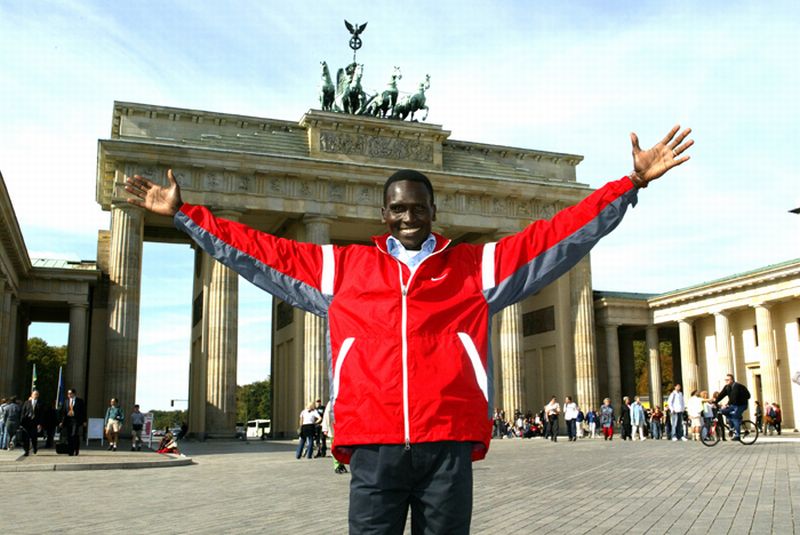
Paul Tergat  - image courtesy of www.runblogrun.com

In comes Paul Tergat. Now if ever there was an athlete who would rival Kipchoge Keino in terms of both national and international appeal, it is Paul Kibii Tergat. He has been on the running circuit until injury and loss of form made him leave the tracks and roads last year. His 5 consecutive titles on the world cross-country circuits, half-marathon and marathon races as well as his memorable but disappointing 2nd place finishes at the Atlanta and Sydney Olympics to another athletics legend Haile Gebreselassie.
Beyond his running exploits he has set up the Paul Tergat Foundation and also set up a private sports marketing firm, FineTouch Communications which handles the SOYA (Sports Personality Of the Year Awards) - an event used to honour Kenyan sports men and women who have excelled within a certain calendar year as well as honour those teams and past heroes too. He has also been serving as a Goodwill Ambassador for WFP- World Food Programme.
And though his sports organisations management may be in doubt, he has cultivated a relationship of mutual respect and honesty with Kenyan corporate firms and sports bodies - a rare feat for many sports people both active and retired. He has also been known to be a consensus builder and has business acumen which he will need to muster to run the NOC-K which still needs regular funding to meet its obligations.
As a former Olympian he did manage to embody the spirit of sportsmanship by not only losing gracefully two times to the same athlete but also cultivating a healthy relationship with his nemesis Gebreselassie. The two took battle from the cross-country tracks to the race tracks in the 10,000m to half-marathons and full marathons. They even broke world records in the marathon between themselves before Kenya's Patrick Makau took the course record in Berlin last year.
We do applaud him on his nomination and do hope the IOC picks him to represent Kenya in the greater Olympics body. It should also be noted that other Kenyan sporting bodies should take the lead of the NOC-K to nominate, vet and elect officials who's track record speaks for itself. Too many charlatans in town are costing Kenyan sport as great fortune and goodwill from their international peers.
Godspeed though to the "Gentleman''  !
  

Friday, 30 March 2012

Road to Olympics - 1972 Munich Games - A Bow before the Lull...


Munich '72
After enjoying a great showing at the Mexico Games 4 years earlier, the expectations from Olympic Games fans were high. But before we get to the actual Games, a brief reminiscence of the year 1972. The world was generally polarised by various political, economic and religious issues.
With the major powers slowly advancing with their Cold War, others busy engaging East Asia tigers which were quickly industrialising. Africa too was now taking a place in the world map as many independent states started encountering upheavals, dictatorships and overthrows. S.Americans too had similar challenges coupled with climatic changes. The Middle East would be thrust into the spotlight for both good and bad reasons relating to the oil crisis, monopolising of the same, terrorism and relentless battles within.
Munich Olympic Stadium - www.ballparks.com

Back to matters sport, Germany had recovered from the World Wars challenges and now becoming a major industrial power thanks to its ingenious enterprising and technical manpower. The city of Munich hosted one of the most memorable Games, both tragic and heroic in equal measure. Here's a look at a few of the highlights;

Interesting Facts:

  • Mark Spitz " 7-star hero" - this was because of his phenomenal performance in the pool tallying a total of 7 gold medals, along with 7 swimming world records. He had done 2 gold in Mexico and thus this was always coming from this human phenomenon. He's one of the most famous and recognizable Olympians ever.
    7-Star Hero - Mark Spitz
  • USSR 'beats' USA  - In one of the most controversial moments of the Olympic Games, the former Soviet Union 'beat' US of A in the basketball final game. After leading 50-49, some flawed timing and calls were made & the Soviets quickly made a basket, before the final horn. The USA team refused to recognise the result and consequently avoided the medal award ceremony for their silver. It has never been awarded to this day.
  • 2 more bans-for-life - As if to spite their fellow Americans, two athletes of African origin were banned for life after taking the awards ceremony 'too casually'...twirling with their medals and not facing the flag as their national anthem was played. Vincent Matthews and Wayne Collett are the culprits!
  • Munich massacre - one of the most infamous incidences to ever occur during the Olympics took place at the Olympic Village where Palestine guerillas attacked the Israeli camp and took hostage of some of their athletes. Eventually 11 Israeli hostages were killed while the Palestinian attackers lost all but 3 of their own. 
  • Future Olympians Kenya's Catherine Ndereba, the late Richard Chelimo and Mozambique's Maria Mutola were born this year.
  • This would also mark the last Olympics before Kenya took an 8 years hiatus from the Games thanks to the Cold War freeze and boycotts to the Montreal Games in 1976 and the Moscow Games in 1980. This also affected the future performances in the sporting disciplines. 
Philip Waruinge - www.life.com

Key Figures &  Results:
  •  7113 participants took part representing a rise by 28% of total participation;
  • 121 countries were represented 
  • 193 competitions were held in 23 sporting disciplines
  • Kenya took part in 4 disciplines same as 1968 - Athletics, Boxing, Hockey & Shooting
  • Kenya won 2 Gold - Kip Keino (3000m steeplechase) & 4 x 400m men's relay; 3 Silver - Philip Waruinge (Featherweight), Ben Jipcho (3000m steeplechase) and Kip Keino 1500m and finally 4 Bronze medals; Julius Sang 400m flat, Mike Boit 800m and Richard 'Dick' Murunga in boxing's welterweight.
  • The Gold in 3000m Men's Steeplechase would mark the start of a winning tradition for Kenya in all Olympic Games it participated in going forward. This would be replicated in major athletic meets such as the World Athletics championships and All-Africa Games among others
  • It would also be the last time Kenya took part in the next 8 years; boycotting Montreal in 1976 and Moscow in 1980 - thanks to the political tensions  and the Cold War increasingly maligning developing countries versus their more developed counterparts.

Friday, 16 March 2012

Road to Olympics : 1968 Mexico Games - Kenya sees Gold !

After participating in 3 consecutive Olympic Games, the country was slowly yearning for better achievements and for this the country's sports personalities were well rewarded. Mexico City - Mexico was also a first of many sorts and it earned a mixed bag of fortunes.

Mexico 1968 - image from www.olympics.org
Let's look at the facts and figures from the Games;

Figures & Results:
'Speed-Cop' Kipchoge Keino - image from Rich Clarkson
  • 5556 participants from 112 countries was a marked improvement from the Tokyo Games '64;
  • 172 events were held in 20 sports disciplines;
  • Kenya participated in 4 sports disciplines - Athletics, Boxing, Hockey and Shooting;
  • Kenya was placed 14th overall, a major improvement on the 1964 Games where she placed  35th.
  • Kenya won 3 Gold namely; Kipchoge Keino-1,500m (M), Naftali Temu-10,000m and Amos Biwott-3000m steeplechase (which was to become Kenya's mainstay for any major events she participated in) ; 4 Silver; Wilson Kiprugut-800m, Kipchoge Keino-5,000m , Ben Kogo-3,000m steeplechase and the 4x400m men's team ( Daniel Rudisha, Charles Asati,Naftali Bon and Munyoro Nyamau); 2 Bronze; Naftali Temu-5,000m and Philip Waruinge -Featherweight boxing;
  • Philip Waruinge was awarded the Val Barker Trophy for the Most Outstanding boxer 'pound-for-pound', despite winning the bronze in Featherweight. He remains the only African boxer to have won the trophy to date. 
  • Kenya's Hockey team finished 8th overall, a drop from the 6th position from Tokyo Games;
  • One John Harun (Mwau) was ranked 76th in Shooting's Mixed Small -Bore Rifle, Prone 50m. (He's currently an MP in Kenya's Parliament having had an illustrious career in the Kenya Police, Interpol as well as the Kenya Anti-Corruption Commission).
Interesting Facts:

  • As quoted in an online forum, this was the first Olympic Games to have 'first large-scale incursion of politics directly in the Olympic venues'.
  • Mexico was the first developing country to host the Olympics. It was also at its 'highest altitude' ever at 2,240m (7,350 ft) a.s.l.(above sea level).
  • Tommie Smith and John Carlos - US 200m (gold & bronze winners respectively)sprinters raised their fists clothed in black gloves during the medal awards ceremony- as a symbol of protest against human rights violation to the Black populace in United States. They also asked Australia's Peter Norman to wear a badge in solidarity with them. This cost them a life ban from any future Olympic Games or IOC-related events which was a bit too harsh if you ask me...
  • Also joining in political protest was one Vera Caslavska - from former state Czechoslovakia ( now Czech & Slovak Republics after fall of communism in Eastern Europe) - her silent protest during medal awards was against Soviet invasion of the state.
  • As noted before, Mexico City has the highest altitude ever for an Olympic event at 2,240m a.s.l - some in athletics were worried about its effects on the athletes including Kenya's own 'speed cop' Kip Keino but this turned out to a blessing in disguise with record-breaking performances from some of the other events.
  • Bob Beamon (US) leapt 8.90m in the men's long jump to what would be one of athletics' most enduring world records. It still is the Olympic record.
  • Sequence of Fosbury Flop - image from www.shorecrest.org
  • Dick Fosbury (US) won the high jump with the unconventional Fosbury Flop. This would eventually be adopted by most if not all high jumpers.
  • One Jacques Rogge (current IOC President) represented Belgium for the first in 3 Olympic Games appearances in yachting. 
  • John S. Akhwari(Tanzania) finished the men's marathon with a dislocated knee and this became a lasting symbol of the Olympic Games spirit - quipped here saying "my country did not send me 10,000 miles just to start the race, they sent me to finish the race. He is currently an Olympic Goodwill ambassador.
  • Tlateloclo massacre - this happened 10 days to the opening of the Games and almost derailed the event. 44 people were killed as students and civilians rioted against 'repressive actions and blatant violation of university autonomy' by the Mexican government. A blown-up kite was flighted during the Games with the black shadow representing a 'silent protest' by the students.
  • Drug-testing debuted to check on performance-enhancing drugs which was becoming a thorn in the flesh for amateur sports.
All in all, the Games marked an improved performance from Kenya and many African countries as most continued enjoying their newly-found independence from their colonial masters.
The Games had now become a major political platform for many States which knew that with the world glued to the television and other media channels, it was the perfect place to send out whatever message - be it silent, symbolic or otherwise.
Commercialisation of sports was also at its formative stages and going into the 1970s, this would form the basis of future sports business for most if not all sporting disciplines and events.

Sources:
International Olympics Committee www.olympic.org
National Olympic Committee-Kenya
Britannica Encyclopedia www.britannica.com
About.com www.about.com
Wikipedia www.wikipedia.com

Wednesday, 22 September 2010

Commonwealth Games: Kenya names her squad but ....

Counting less than 12 days to the Commonwealth Games which start October 3rd - 14th, various sports disciplines have named their squads for the   Games with some already setting up camp at the Kasarani grounds and others too. While the lion's share shall be taken by traditional disciplines such as athletics, boxing, we have the current 'fresh kids-on-the-blocks' in rugby  (from the Rugbykenya blog) and swimming to look out to boost the medal haul. As expected the Government along with the National Olympic Committee(NOC) shall provide the support needed and facilitate the sports people trip to the Asian sub-continent. 
With various concerns about security and hygiene being expressed by inspection teams from participating countries, Kenya's NOC Chairman's Kip Keino words did not sound too convincing and though we shall not banish the Indian organisers, we do hope they put their house in order in good time. It will also a test to future Commonwealth Games organisers as the challenges facing the country seem to hamper sport in a big way.
As for the Kenyan contingent, we shall cheer you on and look for a healthy and well-spread out medal haul. We shall be represented in the following disciplines;
Individual Sports:
Athletics - 60 athletes ( with 16 in the paraplegic Games)
Boxing - 10 boxers
Swimming - 10
Cyclists - 9
Shooting - 6
Badminton - 6
Lawn Ball Bowling - 4
Weightlifting - 4
Table Tennis - 4
Lawn Tennis - 4
Archery - 3

Team Sports:
Rugby ( 7s team)